Chutney, Cord and Cellophane: Dressing Your Homemade Christmas Gifts for 2026
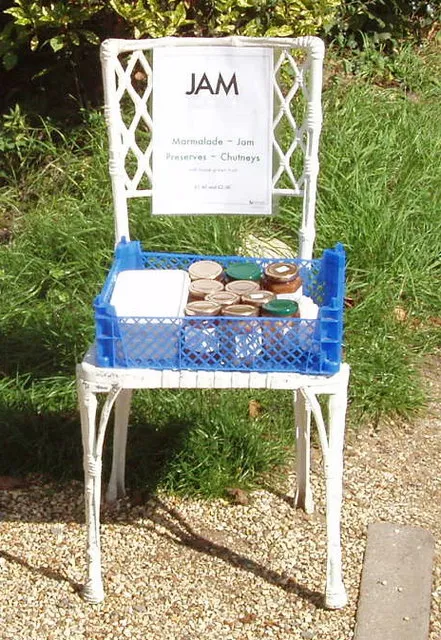
Photo: David Hawgood, CC BY-SA 2.0, via Wikimedia Commons
There's a particular moment in every homemade Christmas: the kitchen is sticky, the chutney is cooling, the sloe gin has been decanted, and you're staring at a row of bare jars wondering how to make them look like presents rather than preserves. That's the bit we can help with.
This isn't about turning your kitchen into a craft studio. It's about a handful of small decisions — where the ribbon sits, what it's tied with, how the tag hangs — that make a jar of mincemeat look like it came from a nice farm shop rather than the back of your cupboard.
Start with the jar, not the ribbon
The first rule of dressing food gifts is that the ribbon is decoration, not packaging. Anything that touches the food or the inside of the lid needs to be food-safe, and most of what's lovely to look at isn't.
A few practical habits worth adopting:
- Tie below the lid, never across the rim. A ribbon wrapped over the top of a jar will pick up grease, vinegar and fruit sugars, and it'll look tired by the time it's opened. Sit the band around the neck of the jar instead.
- Keep ribbon away from the seal. If you're adding a disc of fabric or paper under the lid, make sure it's food-grade and that the lid still seals properly. Greaseproof paper and clean cotton are fine; anything dyed, glittered or scented is not.
- Don't glue to glass you'll reuse. A blob of hot glue on a Kilner jar is a small tragedy. Tie, don't stick — the jar gets a second life and so does the ribbon.
- Label the contents properly. Allergens, alcohol content, the date you made it. Tuck this on the back of the tag in small, neat handwriting. It looks thoughtful and it genuinely is.
The three-element rule
Overdone homemade gifts tend to have one thing in common: too many ideas on one jar. A ribbon, a tag, a sprig of dried orange, a wax seal, a bell, some cinnamon sticks and a handwritten poem is a lot for a 300g jar of marmalade.
Pick three elements and stop. Our favourite combinations:
- Narrow ribbon + kraft tag + one sprig of rosemary
- Jute twine + printed label + a wax seal on the tag (not the jar)
- Velvet ribbon + handwritten tag + a tiny holly leaf cut from felt
That's enough. The jar does the rest of the talking.
A palette that works in a UK kitchen in December
You don't need a colour scheme so much as a narrow selection. Pick four things and buy them in decent quantities in early November — you'll use them on everything from jars to hampers to the biscuit tin.
A palette that photographs well and suits homemade food:
- Natural jute or garden twine — the workhorse. Cheap, compostable, and it makes anything look like it came from a deli.
- Holly green cotton tape — soft, matte, and much more forgiving than satin when it's tied around a curved jar neck.
- Damson or blackberry — a deep purple that flatters chutney, sloe gin and anything with a bit of booze in it.
- Oatmeal or unbleached cream — for tags, labels and any ribbon you want to disappear into the background.
- One accent, used sparingly — a narrow copper or antique gold ribbon for the star gift, not for all twelve.
If you're buying UK-sourced, look for recycled cotton tape, paper-based twine and British-made jute. A lot of what's sold as "natural" twine is imported and heavily dyed; the matte, slightly hairy stuff is usually the real thing.
Ties that survive the car journey
There's nothing worse than arriving at your sister's house to find every jar has slid out of its ribbon. The fix is simple: think about knots, not bows, and test the lift.
- Use a double knot as your base. A single knot on a slippery jar neck will work loose in a bag. Tie a snug double knot first, then add the bow on top of it.
- Swap satin for grosgrain on anything that travels. Satin slides; grosgrain and cotton tape grip. Reserve the shiny stuff for gifts that stay on a table.
- Thread the tag through the knot, not around the ribbon. A tag looped around a bow will work itself free. Punch a hole, thread it onto the ribbon before you tie the final knot, and it can't escape.
- Lift each jar by the ribbon once. If the ribbon slips, retie. Twenty seconds now saves an embarrassed apology later.
- Pack jars upright in a box with newspaper between them. Ribbon survives a journey far better when the jars aren't clinking into each other around the M25.
Bottles need a different approach
Sloe gin, damson vodka and home-made limoncello are the showpieces of a homemade Christmas, and they're also the trickiest to dress. Ribbon around the middle of a bottle covers the label; ribbon over the cap hides the very thing that says "I made this".
Go for the neck. A narrow ribbon — 7mm to 10mm is ideal — wrapped once around the neck and tied in a small, tight bow sits neatly above the label and below the cap. Avoid thick velvet here; on a sloped bottle neck it will sag within an hour.
If you've printed your own labels, tie the tag to the neck rather than sticking anything to the bottle itself. It keeps the label clean and means the recipient can peel the tag off and keep it in a recipe file.
Hampers and biscuit boxes
A hamper is really just a box with good lighting. Layer the base with shredded paper or tissue, stand the tallest jars at the back, and put the small things — cheese biscuits, a bag of coffee, a wrapped wedge of Stilton — in the gaps at the front.
Then wrap the whole box rather than every item inside it. One good ribbon, tied in a proper parcel knot with the tag hanging from the handle, does more for a hamper than eleven individually decorated jars ever will.
For biscuit tins and sweet boxes, tape a square of tissue over the lid, fold the corners neatly underneath, and tie with a single band of ribbon. Add a small card tucked under the band so it doesn't move. That's it. Two minutes, and it looks like you tried much harder than you did.
The last five minutes
Before anything goes in the car, do one final pass. Check the knots. Check the tags are facing outwards. Check the labelling on the back. Then take a photo of the whole lot on the kitchen table, because in three weeks you'll have forgotten what you made for whom, and a photo is the fastest way to remember.
Homemade gifts are generous by definition. All the ribbon has to do is say so clearly — and then get out of the way.